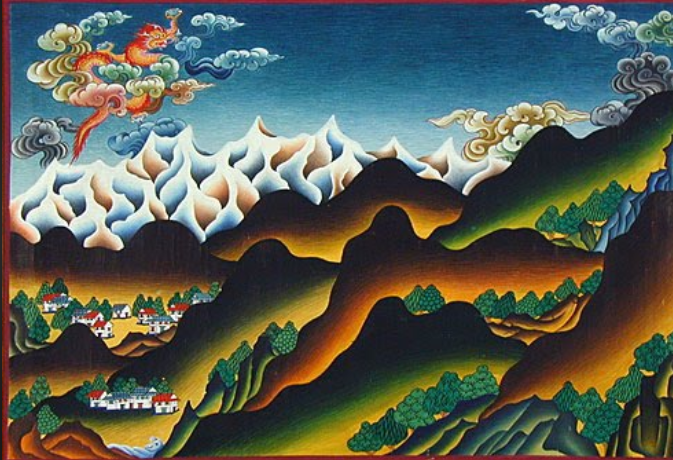


During my speaking tour in the Tibetan settlements of Northeast India, I had the chance to visit several schools. On the notice boards, I saw drawings by the children depicting their vision of “My Home.” Many of these drawings featured cement houses adorned with the Indian flag, and some showed mountains resembling those found in Indian hill stations. In contrast, our own childhood drawings depicted vast grasslands with tents, yaks, horses, and sheep, framed by towering, snowy mountains and clear, crystal rivers flowing through the valleys. It deeply concerns me to see how the vision of their homeland is gradually fading for Tibetan children growing up in exile.

Fortunately, today I had the opportunity to attend the “Dreaming Tibet” art exhibition by KHADOK at the Kangra Art Museum. The exhibit was both encouraging and inspiring. It featured drawings by school students that not only showcased the stunning environment of Tibet but also highlighted the harsh realities faced by Tibetan children in colonial boarding schools—institutions designed to erase their cultural identity. One writing included the poignant wish, “Oh, I wish one day this art can become reality.”
Another child wrote, “Just tasting our country’s fresh air and its smell would be enough.” These artworks uplifted my spirits and reinforced my hope that Tibetan children will one day experience and cherish the beauty of Tibet before it is irrevocably damaged by the Chinese communist regime under the guise of various projects.

One particularly striking drawing featured a yak with a man’s leg. The accompanying note read, “If I get back to Tibet, I will buy the yak’s costume and play with it.” I hope these children understand that yaks still roam in Tibet, and that it is possible to play with real yaks if we can return soon. However, with the increasing implementation of harsh policies forcing the resettlement and relocation of nomads, a time may come when only images and costumes of yaks remain.

It is therefore crucial and urgent to address the Sino-Tibet issue to preserve Tibet’s beauty before it is lost. Art plays a vital role in fostering a sense of nationalism and activism among young people. I sincerely appreciate KHADOK’s efforts in this project and encourage other artists, singers, musicians, actors, and creatives to contribute their talents to our cause. If all Tibetans unite and harness their skills and passions, I am confident that the light of freedom will soon shine upon Tibet.

