"I have enough time to rest, but I don't have a minute to waste". Come and catch me with your wise words and we will have some fun with our words of wisdom.
Although Tibetan singer Asang has been released by the Chinese government, his family remains under tight control, particularly online. Asang and his wife have found it challenging to resume their online business via their well-known social media platform, encountering repeated disruptions. Additionally, visits from family members have been scarce since his release, a situation largely attributed to the stringent measures and oversight enforced by the Chinese authorities.
“One of the saddest things about being a refugee is that you often dream of your homeland. Even in the dream, you wish it wasn’t a dream, only to wake up to a deep homesickness.”
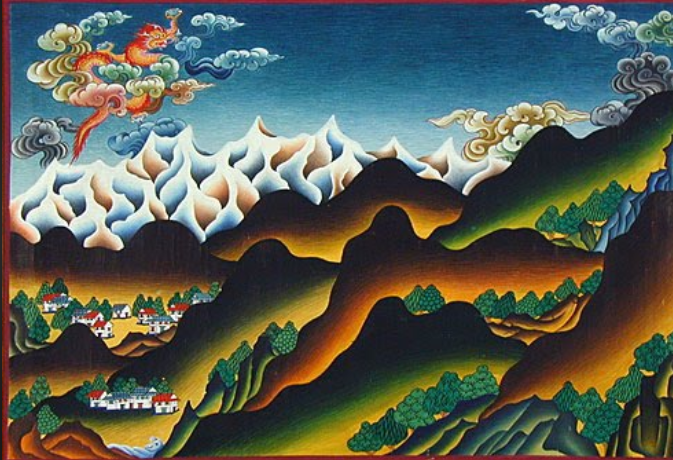
During my speaking tour in the Tibetan settlements of Northeast India, I had the chance to visit several schools. On the notice boards, I saw drawings by the children depicting their vision of “My Home.” Many of these drawings featured cement houses adorned with the Indian flag, and some showed mountains resembling those found in Indian hill stations. In contrast, our own childhood drawings depicted vast grasslands with tents, yaks, horses, and sheep, framed by towering, snowy mountains and clear, crystal rivers flowing through the valleys. It deeply concerns me to see how the vision of their homeland is gradually fading for Tibetan children growing up in exile.
Fortunately, today I had the opportunity to attend the “Dreaming Tibet” art exhibition by KHADOK at the Kangra Art Museum. The exhibit was both encouraging and inspiring. It featured drawings by school students that not only showcased the stunning environment of Tibet but also highlighted the harsh realities faced by Tibetan children in colonial boarding schools—institutions designed to erase their cultural identity. One writing included the poignant wish, “Oh, I wish one day this art can become reality.”
Another child wrote, “Just tasting our country’s fresh air and its smell would be enough.” These artworks uplifted my spirits and reinforced my hope that Tibetan children will one day experience and cherish the beauty of Tibet before it is irrevocably damaged by the Chinese communist regime under the guise of various projects.
One particularly striking drawing featured a yak with a man’s leg. The accompanying note read, “If I get back to Tibet, I will buy the yak’s costume and play with it.” I hope these children understand that yaks still roam in Tibet, and that it is possible to play with real yaks if we can return soon. However, with the increasing implementation of harsh policies forcing the resettlement and relocation of nomads, a time may come when only images and costumes of yaks remain.
It is therefore crucial and urgent to address the Sino-Tibet issue to preserve Tibet’s beauty before it is lost. Art plays a vital role in fostering a sense of nationalism and activism among young people. I sincerely appreciate KHADOK’s efforts in this project and encourage other artists, singers, musicians, actors, and creatives to contribute their talents to our cause. If all Tibetans unite and harness their skills and passions, I am confident that the light of freedom will soon shine upon Tibet.
I have recently completed reading Kungo Tashi Wangdi la’s memoir, “My Life – Born in Free Tibet, Served in Exile.” The author’s lifelong devotion to the Tibetan cause is truly inspiring and edifying, exemplifying the unwavering commitment of the older generation. Kungo la’s narrative provides a candid and transparent account of his life, from his childhood memories in a free Tibet to the challenging initial experiences of exile. He recounts leaving loved ones behind in Missamari to pursue education in Mussoorie and subsequently dedicating himself to exile governance when his skills were most needed.
The memoir poignantly portrays the deplorable living conditions during their tenure at the Central Tibetan Administration, including the cramped, rat-sized rooms they shared. The countless times they traversed the distance between McLeod Ganj and Gangkyi, Gangkyi and Dharamshala on foot, even for the smallest tasks, demonstrate remarkable dedication and resilience.
Throughout his career, Kungo la served as a Kalon (minister) in various capacities across all departments except Finance. Notably, he held roles as a bureau officer and was responsible for accompanying His Holiness the 14th Dalai Lama on numerous international visits, providing detailed accounts of travel assistance and the leaders met during these visits. Kungo la’s involvement in the Kalon Tripa (Prime Minister) election, marked by his active engagement in campaign activities and unwavering commitment to democratic principles, is especially commendable.
His continued service in various capacities post-retirement further demonstrates his enduring commitment to Tibet’s cause. The detailed accounts presented in this memoir serve as a testament to the transparency and sincerity characteristic of elder Tibetan statesmen of Kungo la’s stature. His life story provides valuable insights into the Tibetan Freedom Movement and the dedication of those who have devoted their lives to this cause. There are life lessons to be learned by all Tibetans, especially civil servants in the Central Tibetan Administration.
Kungo la has graciously shared the humorous situations from his life in his memoir, with the intention of bringing joy and levity to the reader. Furthermore, he has demonstrated remarkable courage in addressing certain remarks made in the “Noodle makers of Kalingpong”, which pertained to him personally and required a bold response.
It is also important to note that, despite its thickness, the memoir is written in accessible language, rendering it an effortless read. The pages will unfold with ease, much like a flowing stream, once the reader embarks on this engaging narrative.
Kungo la, like many of his contemporaries, remains steadfast in his belief in the ‘good will and support of the Chinese people’. I earnestly hope that the Chinese people will meet the expectations of our esteemed elders and demonstrate moral integrity, thereby contributing to the welfare of Tibet and their own future. However, it is also important to recognize that, should this not transpire, the Tibetan youth will remain steadfast in our commitment to our cause. Our resolve and resilience will only intensify as the situation within Tibet continues to deteriorate with each passing day.
I had the privilege of meeting Kungo la during a recent former executive meeting of the Tibetan Youth Congress, held at the TYC office, and was profoundly inspired and encouraged by his visionary outlook and unwavering dedication to the cause.